You can turn a bookshelf into a room divider by measuring first, then choosing a unit that leaves about 3 feet of walking space. I like open-backed IKEA KALLAX or BILLY shelves because they split a room without killing daylight—my family calls them “the no-cave fix.” Use half-height units for sightlines, taller ones for privacy, and style both sides with books, plants, or baskets. Keep going, and I’ll show you which divider fits your space best.
Key Takeaways
- Open-back shelves like étagères or IKEA KALLAX divide rooms while preserving light and sightlines.
- Choose divider height carefully: low consoles, half-wall bookcases, and floor-to-ceiling units serve different privacy needs.
- Measure walking paths first; keep at least 36 inches of clear passage around the divider.
- Double-sided or back-to-back bookcases add stability and storage, especially in center-of-room placements.
- Style both sides with books and decor, and use closed backs only when you need to hide clutter.
What Makes a Bookcase Divider Work?
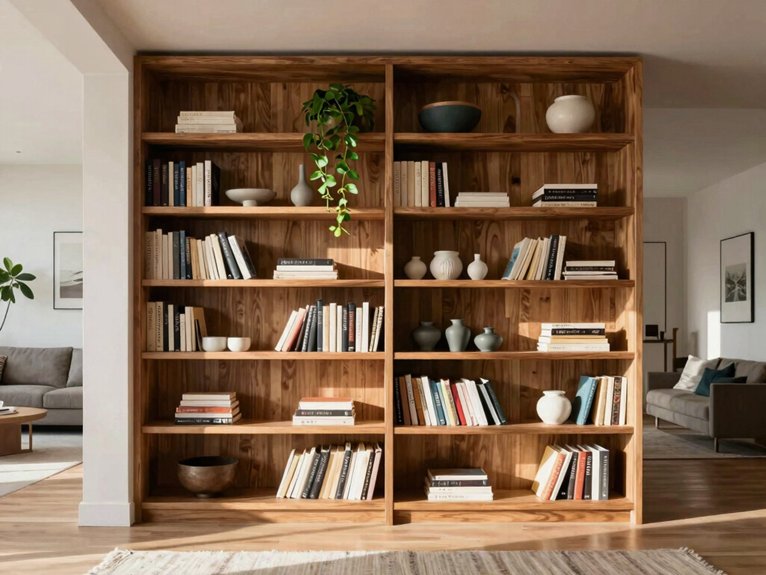
A good bookcase divider does more than just stand there and look nice—it earns its keep. I’ve seen open-back étagères and see-through five-by-five shelves in tiny NYC apartments, and they nail visual permeability. You get light, books, plants, and the odd souvenir mug, without turning your room into a cave.
In my own home, a half-wall-height bookcase helps my family keep traffic flow easy while still marking a cozy zone. If you want a centered divider, go double-sided for stability and shelves on both sides. Open units feel airy; closed backs hide the mess when life gets gloriously chaotic.
Measure Your Space First
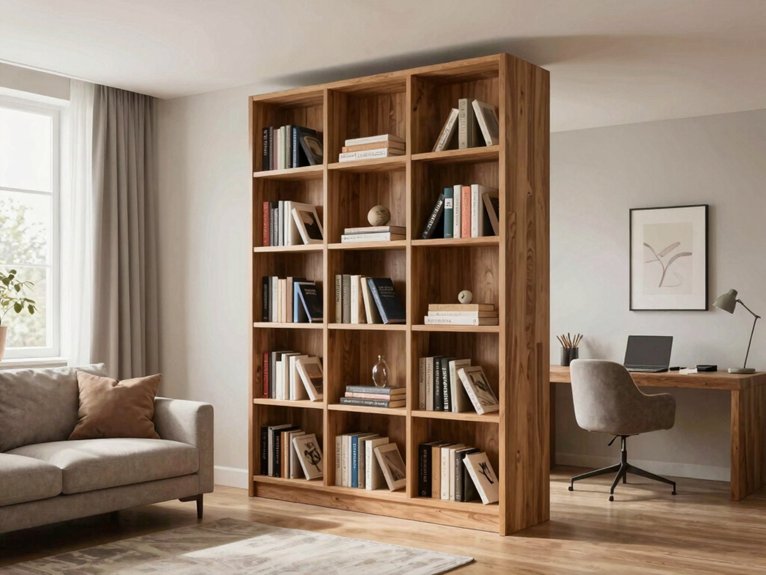
Once you’ve found a bookcase divider that feels airy and useful, the next move is to measure your space like you mean it.
I keep a measurements checklist: footprint, doorway width, and where your feet actually walk. Aim for at least 36 inches of clear passage, since many doors are about 32 inches wide.
For a freestanding divider, leave a few feet on each side so nobody bumps books while carrying laundry. I also measure lamp tops, plants, and my kid’s ever-growing monitor stand.
Clearance planning now saves awkward shuffles later, and yes, your shins will thank you.
Pick the Right Divider Height
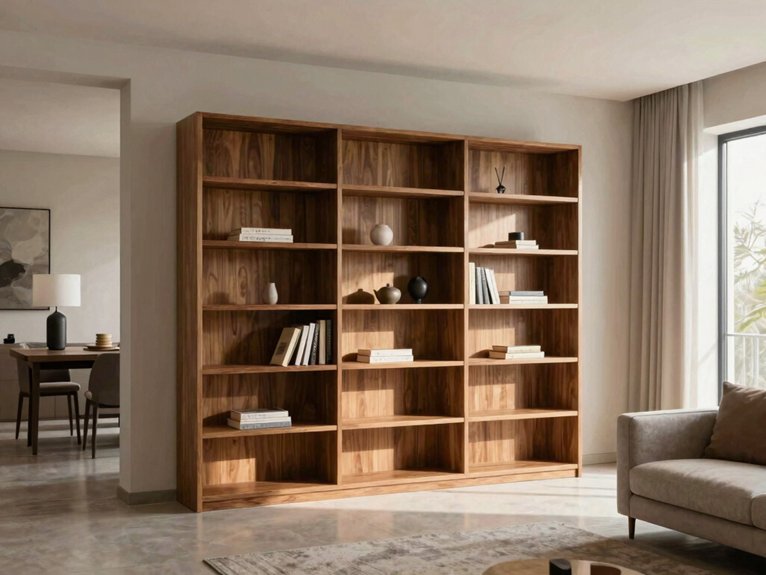
When I’m choosing a divider, I usually start with a half-wall height of about 3 to 4.5 feet because it gives you privacy without turning your room into a cave, and it’ll hide most gear like an elliptical or Peloton pretty well.
If you want the space to feel open and bright, a console-height bookcase around 2.5 to 4 feet can mark the zone while still letting light and sightlines stay friendly.
Go full-height when you need real separation for a bedroom, office, or library feel—just make sure it fits the items around it, and if it’s standing in the middle of the room, I’d anchor it so nobody gets a surprise wobble drama.
Half-Wall Privacy Balance
Choosing the right divider height can make or break the feel of a room, and I’ve learned that the hard way while rearranging our own family spaces. A half wall bookcase at 3 to 4.5 feet gives you daylight balance and partial privacy, so your room still feels friendly.
I like console-height units too; they mark a zone without boxing it in. In our 420-square-foot studio, a 2.5-foot shelf kept sunlight moving and hid the treadmill enough for sanity.
Keep a 3-foot path open, and check for desks, monitors, or bikes before you buy.
Full-Height Division Power
If a half wall keeps things open, a full-height divider goes all in, and I’ve used that effect more than once to tame a messy room.
You get real privacy, plus floor ceiling presence that says, “This zone is mine.”
- Choose a sturdy, double-sided bookcase for the center.
- Go floor ceiling only if you want extra storage and don’t mind a higher bill.
- Keep a 3-foot pass so nobody has to sideways-shuffle.
- I like back-to-back units; they work hard and look neat, even when my family drops shoes nearby.
Choose Open Shelves for More Light
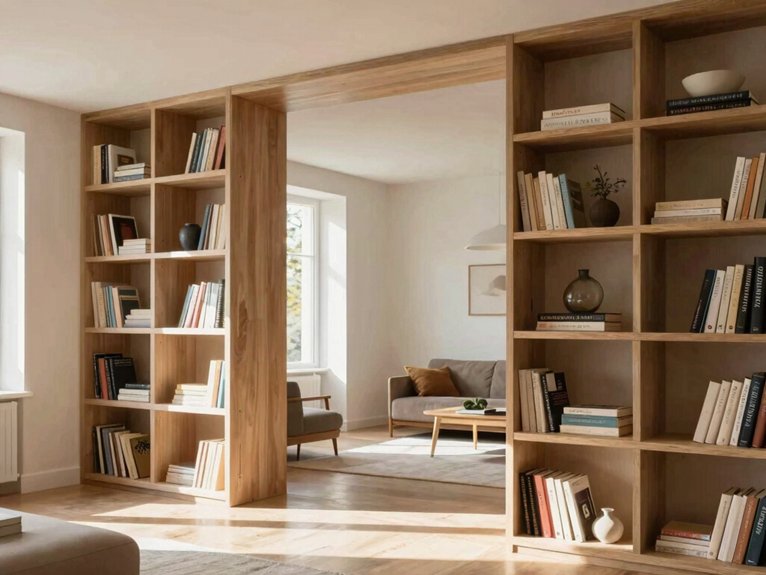
I’ve found that open-back étagères and see-through systems like IKEA KALLAX let you split a room without stealing the daylight, so your space still feels airy instead of boxed in.
In my own home, a half-height bookcase or a back-to-back setup has worked well for books, plants, and the random trinkets my family insists on keeping, while keeping clear views across the room.
If you want a bigger statement, floor-to-ceiling built-ins with open shelves or painted backs can frame your things and still let light sneak through, which is a nice win for small studios and my sanity.
Light-Filled Open Shelving
A good open shelf divider can do two jobs at once, and that’s why I keep coming back to them in small spaces. When you choose airy étagères or see through shelving, you let sunlight travel while still carving out a cozy nook for you and your crew. I’ve used open-backed cubes and metal frames in rentals, and they never feel heavy.
- Half-wall shelves keep daylight moving.
- Shallow depths make rooms feel open.
- IKEA KALLAX-style cubes store books and plants.
- Open backs skip ugly finishing work.
Go for light, and your home feels friendlier.
See-Through Storage Dividers
See-through storage dividers keep the room bright while still giving you that nice “this is my zone” feeling. I’ve used open-backed shelves in tight homes, and they help you belong to your space, not fight it. | Type | Why it works |
| — | — | |
|---|---|---|
| Five-by-five shelf | Lets light pass through | |
| Étagère | Feels airy, not heavy | |
| Half-height console | Keeps sightlines open | |
| Tall open bookcase | Marks zones distinctly | |
| Minimalist grids | Hold books, plants, and odds | My family likes the Analiese 4-shelf etagere, and anti-tip hardware makes me relax. Translucent panels aren’t needed here; the openness does the job. |
Airy Zones, Clear Views
When I need a divider that won’t steal the sun, I reach for open-backed shelves and airy grid units. In my family’s tiny studio, a five-by-five KALLAX keeps books, plants, and the odd mug in order, while light still slips past.
You’ll love low consoles, too; they mark a nook without turning your home into a cave.
- Use open backs for bright flow
- Pick half-height pieces in small rooms
- Choose double-sided units for center spots
- Add cutouts or glass panels near a high ceiling
Finish the reverse side neatly, and your space feels calm, shared, and welcoming.
Use Closed Storage for Privacy
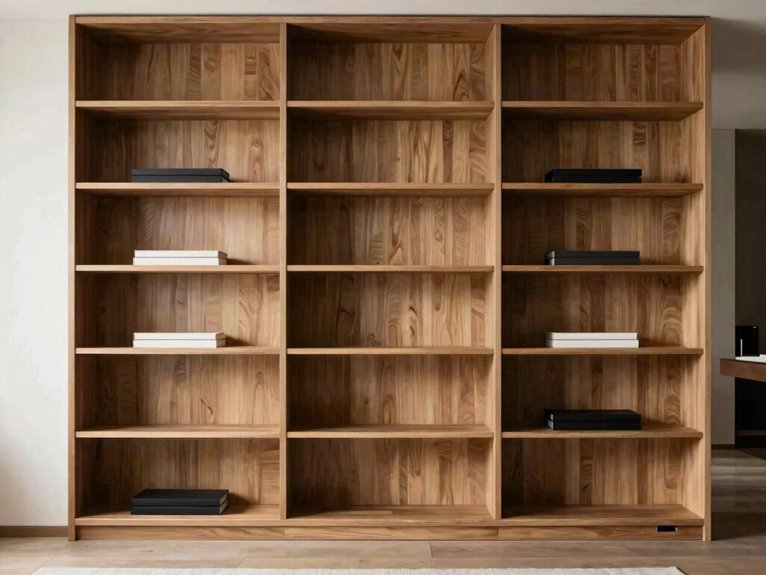
I’ve found that closed storage can work like a quiet wall, especially when you need a room divider that does more than just mark a boundary. I like privacy focused cabinetry and closed back solutions because they hide the mess and help your space feel calmer, not crowded.
In my family’s studio, a door-front unit kept coats, shoes, and the mysterious stuff kids “saved” out of sight. For renters, choose freestanding closed units; for permanence, go floor-to-ceiling.
Half-height pieces still let light pass, but full-height models block desks, beds, and treadmills. That’s real privacy, with less visual drama.
Freestanding Bookcase Divider Ideas
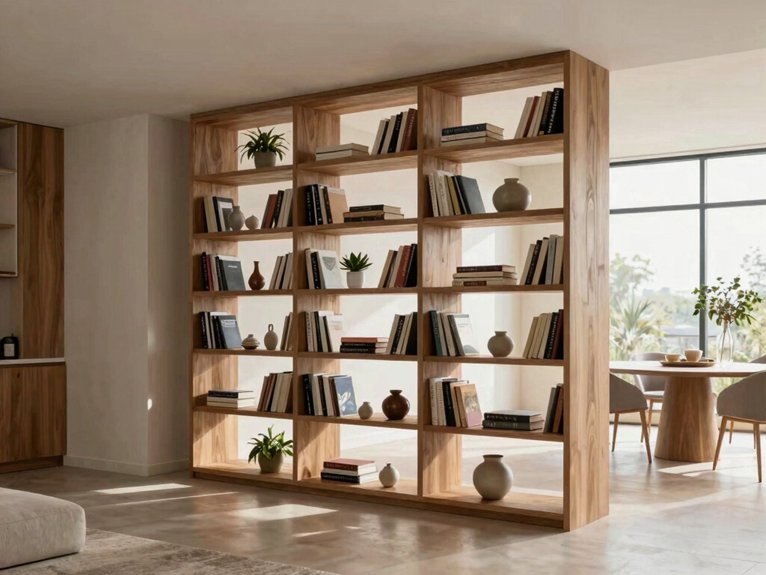
A freestanding bookcase can act like a friendly wall. I’ve used one in my own family’s small space, and it really helps you feel settled without shutting people out.
Choose an open-back étagère or a KALLAX-style cube for modular styling; it lets light move through and keeps traffic flow easy.
- Go with back-to-back units for a sturdy center divider.
- Pick console-height shelves to mark zones.
- Use full-height pieces when you want more privacy.
- Leave a 3-foot opening, and anchor tall units.
I love how books, plants, and keepsakes make it feel like home.
Built-In Bookcase Divider Ideas
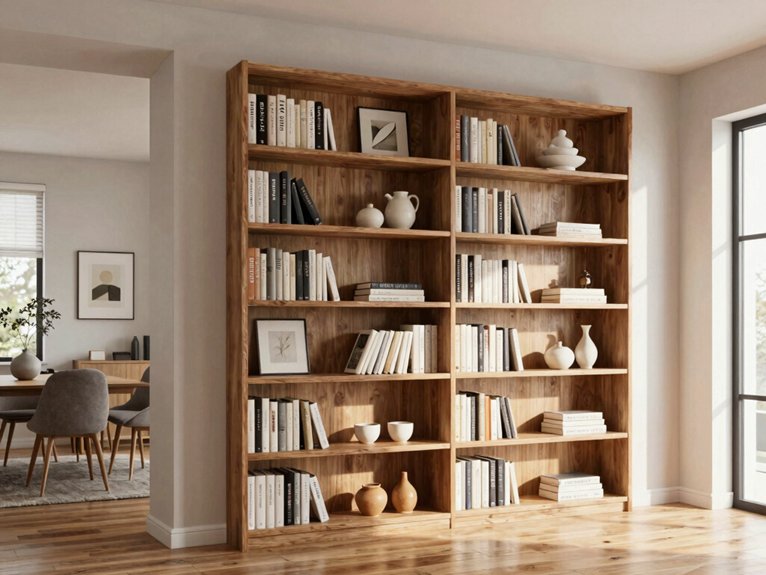
Built-ins can feel like architecture, not just furniture, and that’s what makes them such a strong room divider. I’ve seen families use them for a permanent installation that marks the line between a den and dining nook, while still making everyone feel included. Choose custom integration with trim, painted backs, or molding so the unit looks like it belongs.
Off-white tones keep a bedroom divider airy; darker finishes add coziness. If you want both sides neat, a double-sided build works best, though it costs more. Leave a 3-foot path, and anchor it to studs so nobody gets a surprise wobble.
Floor-to-Ceiling Divider Ideas
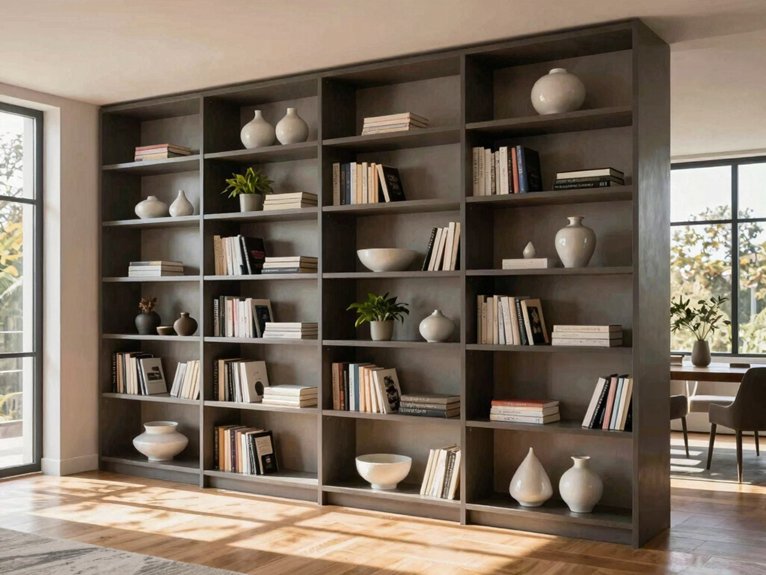
When you need a divider that really means business, floor-to-ceiling built-ins can turn one room into two without feeling flimsy. I’ve seen them create privacy thresholds that make a bedroom, office, or gym feel tucked away, and my family loved the calm. They also keep floor height continuity, so the split feels planned, not chopped up.
- Add trim for a built-in look.
- Paint the backs robin’s egg blue.
- Pack shelves with books, baskets, and bins.
- Use tall units, anchored well, for renters.
They cost more, sure, but wow, the storage is huge. My books nearly staged a coup.
Low-Profile Divider Ideas
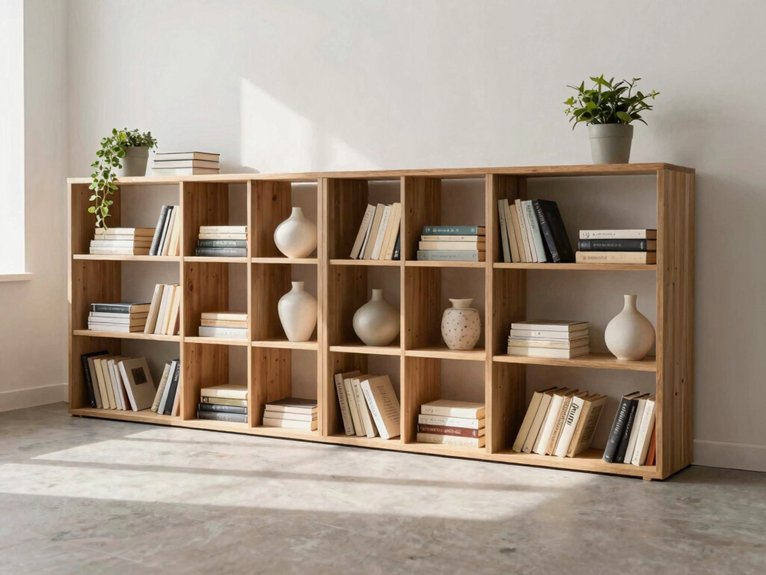
I’ve found that a low-profile divider, like a 2.5-to-4-foot storage unit or a short console-height bookcase, can split your studio into clear zones without turning it into a cave.
You can tuck one beside your bed or behind your sofa, then stack books, plants, or a little sculptural decor on top so it works harder than my family after a holiday dinner.
Best of all, you keep the light, the views, and the easy walk-through space, so your room feels open instead of boxed in.
Low-Profile Zone Definition
Low-profile dividers can do a lot of heavy lifting without stealing the room’s breath. I’ve seen mini shelving and a low credenza turn one studio into two cozy zones, and it felt like instant belonging. Put one beside your sofa or bed, and you’ll mark the edge without blocking light.
- Use a 30-inch console-height bookcase in a 350-sq-ft space.
- Top it with a lamp, plant, or small art.
- Add stacked books for a little height.
- Try tall stems for privacy, not walls.
My family likes this trick; nobody feels boxed in, even when the cat claims every shelf.
Compact Divider Storage
A small divider can carry a surprising amount of storage without making your room feel crowded. I’ve used console-height bookcases in my own 400-sq-ft setup, and they made the space feel organized, not boxed in.
Try modular cubbies or vertical baskets for shoes, scarves, and mail; they keep clutter in one friendly spot. Put the divider near your bed or entry to mark a zone, but leave about 3 feet for easy walking.
I like low étagères with stacked books and plants on top—my family calls it “the civilized clutter zone.” Open-backed shelves work great, too.
Light-Friendly Room Separation
- Tuck one behind a sofa.
- Place one beside a bed.
- Use plants or stacked books for extra privacy.
- Anchor short units for safety.
A 400-sq.-ft. NYC shelf can hold books and still let light dance through.
See-Through Bookcase Divider Ideas
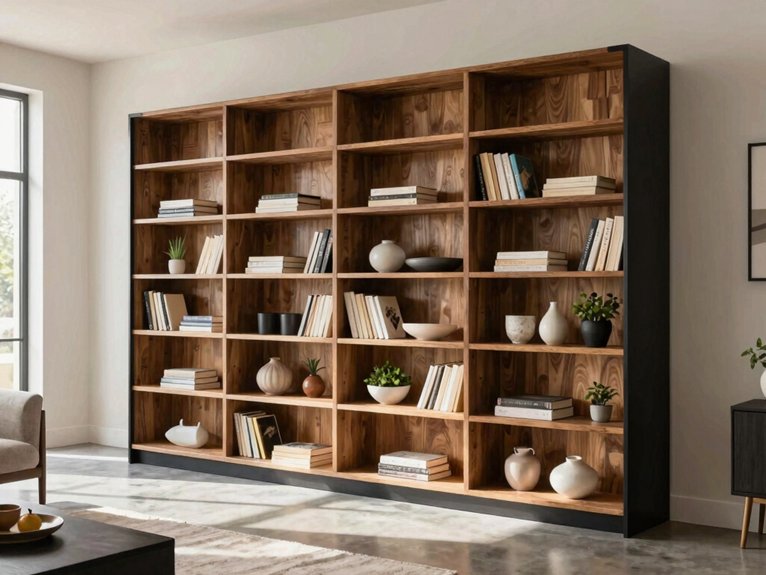
See-through bookcase dividers are one of my favorite tricks for splitting a room without making it feel boxed in. You get transparent shelving that lets light travel, plus airy partitions that still give each area a clear job.
I love open-backed étagères and square systems like IKEA EXPEDIT or KALLAX because you can style both sides with books, plants, and the odd trinket my family keeps “borrowing.” In a 400-square-foot NYC apartment, a five-by-five unit carved out space without gloom. Just anchor it well and add anti-tip hardware, because nobody wants a wobbling wall of books.
Geometric Bookcase Divider Ideas
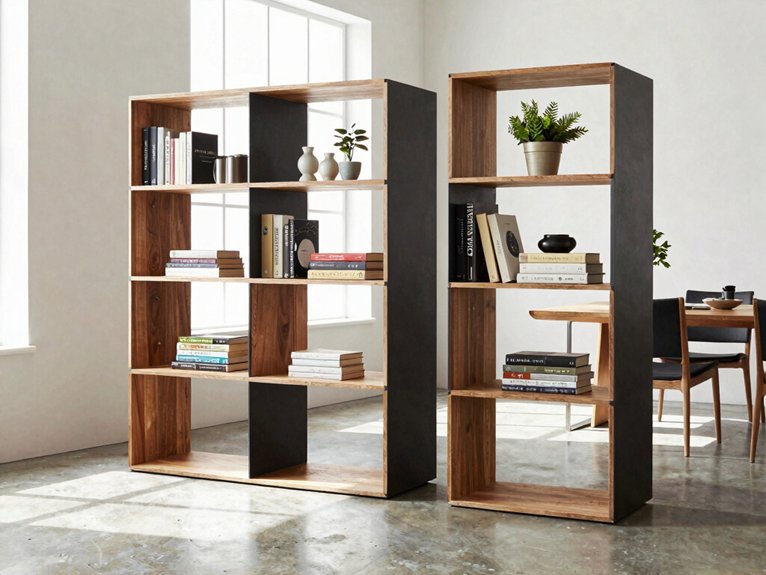
If you liked the airy feel of open-backed shelves, geometric bookcase dividers push that idea a step beyond with a more sculptural look. I’ve found they fit right in when you want your space to feel like it belongs to everyone at home, not just one corner.
- The Okane’s asymmetrical silhouettes make books look curated, not crowded.
- Open sides let geometric lighting and daylight move through.
- Melamine or metal frames stay sturdy with wall brackets.
- Prices range from Jayvianna’s $88.99 to Kyler’s $570.
Check reviews, because tricky assembly can test even patient families, mine included.
Louvered Divider Bookcases
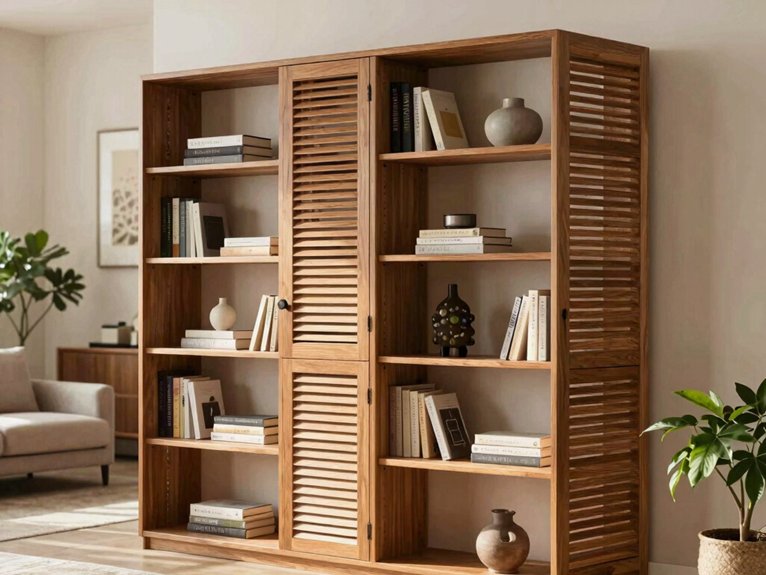
I’ve seen rustic louvers on 6-panel dividers that arrive fully assembled, fold with two-way hinges, and still look sharp after family chaos.
You can pick kiln-dried frames or carved styles with adjustable shelves for books and plants.
Some even give you airflow, so your nook won’t feel boxed in.
My family likes that they store flat when not needed.
If you want a room that feels welcoming, these pieces help you claim your corner without shutting everyone out.
Folding Screen Bookcases With Shelves
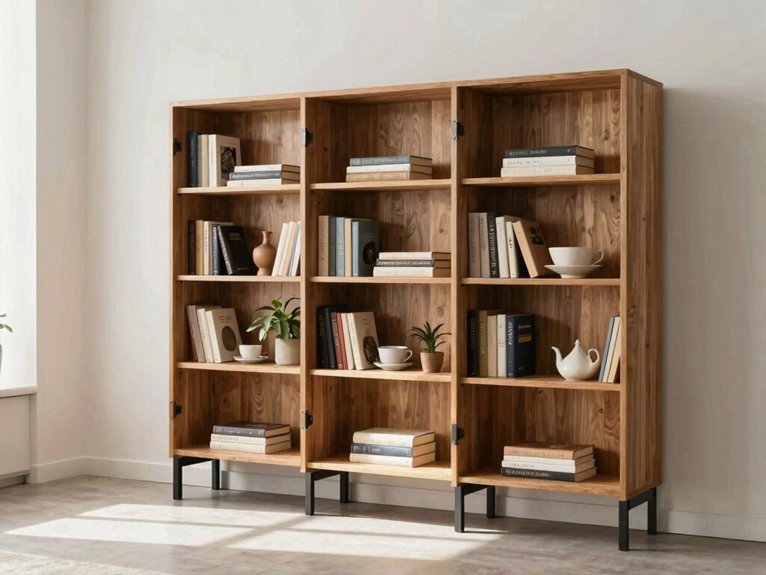
When you want portable privacy with a little style, folding screen bookcases with shelves can work hard for you—they block sightlines, let light filter through the slats, and still give you spots for plants, books, or that one mug your family keeps “borrowing.”
I’ve liked how models like Winston Porter’s two-way hinged divider and Ophelia & Co.’s carved louvered partition fold up fast, so you can move them from a bedroom to a home office without wrestling a giant wall.
My family loves that they look tidy even when life doesn’t, and honestly, a divider that can hide clutter and hold decor feels like a small miracle.
Portable Privacy
I’ve found that a folding screen bookcase can be a sneaky-smart way to buy yourself some peace, especially in a busy home where everybody seems to need the same corner at the same time.
You get temporary screens that feel like renter friendly panels, and you can move them when your needs shift.
- A 6-panel rustic divider spans 95 inches.
- Rose Home Fashion options use louvered slats and sturdy frames.
- Winston Porter styles fold flat for quick storage.
- Ophelia & Co. adds adjustable shelves, though it needs more floor space.
I like that you can set one up fast, then stash it later.
Light-Filtering Storage
If you liked the quick privacy of a folding screen bookcase, here’s the part I really enjoy: it can also work like a light-friendly storage wall. I’ve watched a rustic 6-panel louvered screen, about 95 inches wide, give my family room filtered shelving and a warm glow, not a cave. The two-way hinges let me angle it just right, and the solid wood panels feel sturdy.
If you want a smaller budget pick, Winston Porter and Rose Home Fashion both fold up neatly. I use translucent panels and shelves for books, plants, and the random stuff life dumps on us.
Double-Sided Bookcase Dividers
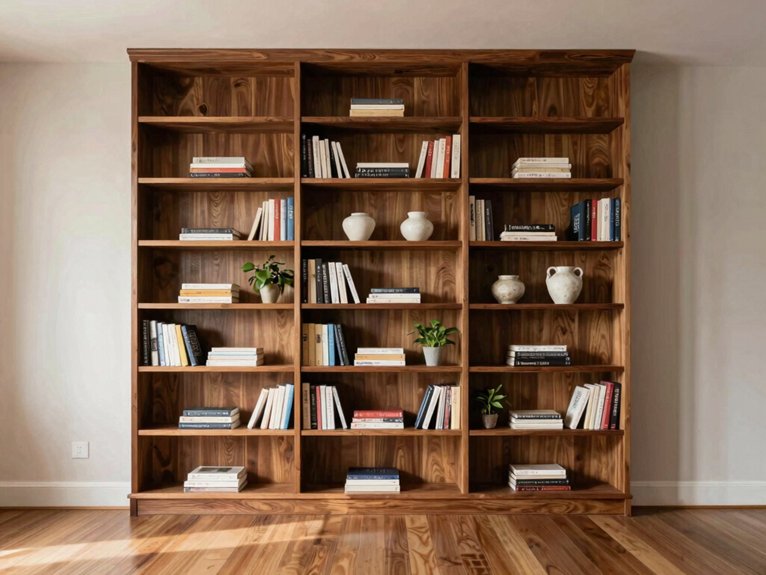
Back-to-back bookshelves can make a room feel pulled together fast, and they’re one of my favorite divider tricks because they work hard without looking fussy.
I’ve used double sided styling to create a shared edge that feels friendly, not awkward. When the seam bugs you, try seam treatments like plywood, veneer, or wallpaper.
- Hunt Craigslist or Facebook Marketplace for sturdy finds.
- Choose open-backed KALLAX-style cubes for more light.
- Anchor tall units; nobody wants a wobble.
- Use trim or books to hide tiny gaps.
I like console-style pieces, too; they stand proudly in the middle and still feel welcoming.
Bookcase Divider Ideas for Studio Apartments
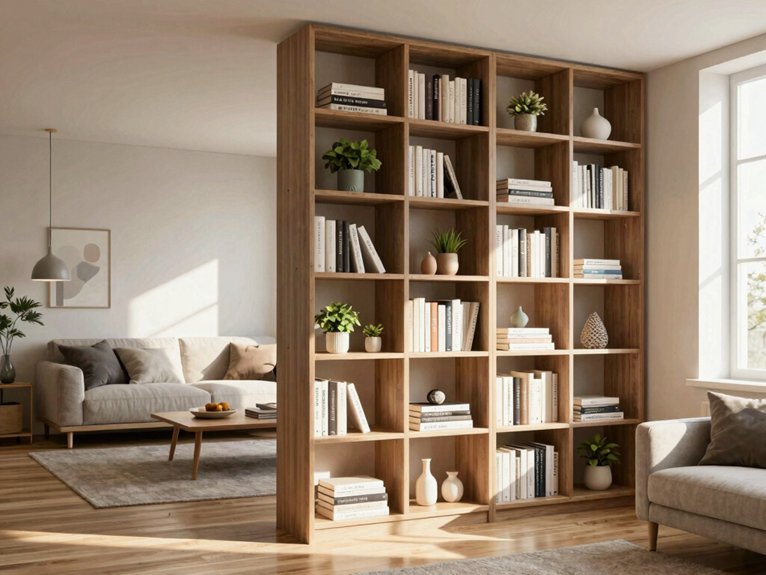
If you live in a studio, an open-backed bookcase can give you a real sleeping nook without stealing all your daylight, which is a small miracle when your couch and bed are essentially roommates.
I’ve seen low 2.5–4.5 ft dividers, see-through IKEA BILLY pairs, and airy etagere shelves do the job beautifully, since they split the room, add storage, and still let you wave at the sunlight.
For tiny spaces, I’d reach for a low console or half-wall shelf so you get privacy, a spot for shoes or coats, and less “furniture wall” drama than your family asked for.
Open-Back Light Flow
How do you divide a studio without turning it into a cave? I’ve found open-back étagères keep your room feeling like a shared home, not a bunker. In my family’s 400-square-foot apartment, a five-by-five shelf let light sail through while books, plants, and the odd ceramic frog stayed put.
- I use shorter console-height bookcases to mark sleep and lounge spots.
- I like back-to-back units for visual permeability and maximizing daylight.
- I choose floor-to-ceiling open shelves when I need more storage, not gloom.
- I pick renter-friendly frames because no one wants a sad, finished backside.
Divide Without Blocking
When I want my studio to feel open but still split into real zones, I reach for a bookcase divider that doesn’t block the whole view. In my own place, open-back étagères and five-by-five grids let me optimize light while marking out sleep and work corners.
A half-wall bookcase, about 3 feet tall, gives my family a clear edge without turning the room into a maze. I’ve also seen two IKEA BILLY units set back-to-back; they’re renter-friendly and easy to move.
Choose slender profiles so your space stays airy, bright, and kind of magical, not cave-like.
Storage Plus Privacy
I love a bookcase divider that pulls double duty, because my family’s stuff has a sneaky habit of multiplying. In your studio, you can claim floor space and still feel cozy.
Back-to-back IKEA BILLY units work well in a Chicago studio, giving you hidden storage and a real privacy boost without a custom build. Open-backed étagères keep daylight moving, so your nest won’t feel boxed in.
- Try low-profile dividers in tiny rooms.
- Use privacy textiles on nearby openings.
- Add favorite books and art.
- Choose freestanding or folding styles if you rent.
Bookcase Divider Ideas for Small Condos
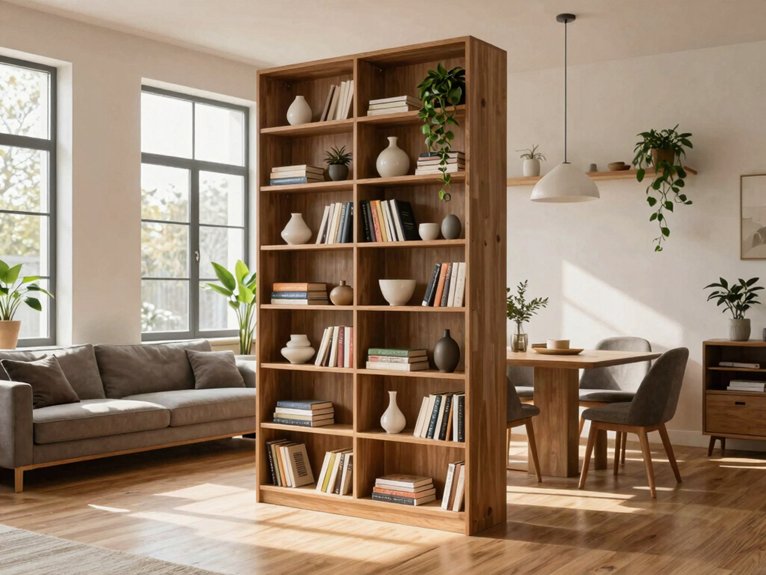
Bookcase dividers have become one of my favorite small-condo tricks, because they pull double duty without acting like a giant wall.
In my tiny Chicago place, a divider bookcase added storage and kept the space feeling open. You can do the same with low-profile units, or try two IKEA BILLY bookcases back-to-back for a budget-friendly split.
I like open-backed shelves because they let light pass through, and you can tuck in books, plants, even vertical greenery or acoustic panels.
When I helped my cousin set one up, it made the condo feel organized, cozy, and oddly welcoming.
Bookcase Divider Ideas for Lofts
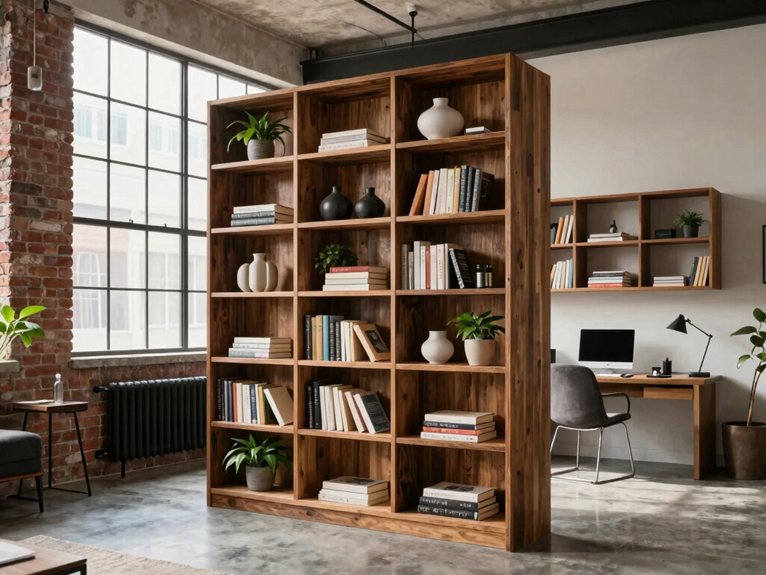
In my family’s loft, I’ve seen how a pair of tall bookcases can split a big room into sleep, work, and hangout zones without blocking those sunny windows, which feels like magic with shelves.
You can use matching EXPEDIT or KALLAX units, back-to-back bookcases, or even floor-to-ceiling built-ins to get privacy and still let light filter through—because no one wants their loft to turn into a cave.
Just keep a 3-foot walkway, and anchor the shelves well so your “room divider” doesn’t decide to wander during a busy morning.
Defining Loft Zones
When I’ve seen a loft feel a little too open, the fix can be as simple as placing a bookcase where a wall would normally go. You can claim your own cozy zones without losing the airy vibe. I’ve done this with my family, and it changed everything for loft acoustics and daylight zoning.
- Pair two tall units for work and sleep areas.
- Try an Okane 52″H x 52″W divider.
- Use open-backed étagères for books, plants, and trinkets.
- Keep a 3-foot path for safe traffic flow.
Low BILLY units work too, if you want easy, flexible order.
Light-Friendly Privacy
If you want your loft to feel private without turning into a cave, I’ve had good luck with bookcase dividers that act more like helpers than walls.
In my family, we use open-back étagères and KALLAX-style squares to set a reading nook, desk, and sleep area apart while sunlight still slips through. Pairing two identical bookcases back-to-back gives me a sturdy center divider, and a half-wall unit keeps sightlines open.
I like soft glazing or ambient translucency on closed backs, plus a 3-foot walkway and wall anchors. It’s privacy with room to breathe, not fortress mode.
Bookcase Divider Ideas for Primary Bedrooms
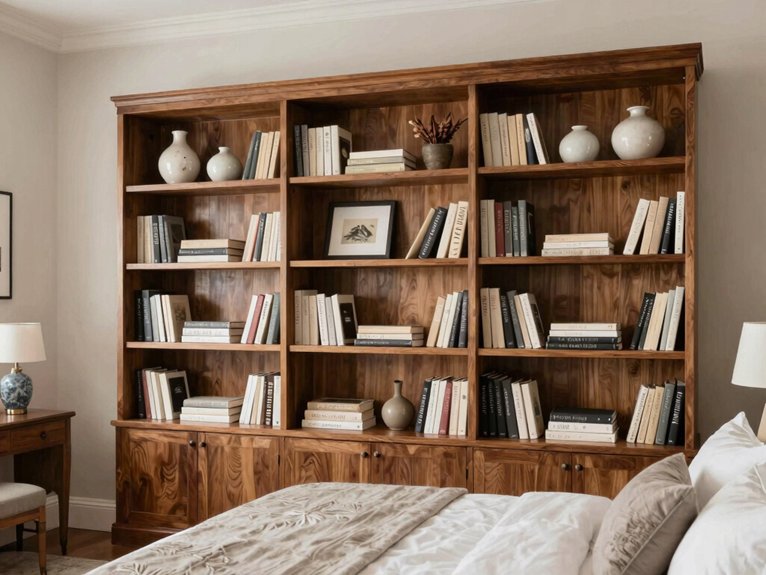
One sturdy bookcase can do a lot of heavy lifting in a primary bedroom, and I’ve seen it turn an awkward open layout into a calm, useful retreat almost instantly. You can claim your own corner with style, and your stuff still feels close by.
A floor-to-ceiling built-in makes a bold wall; I’d add soundproofing options behind it and think about bedside integration with a lamp or caddy.
- Use a half-wall for light.
- Try back-to-back units in the center.
- Pick open-backed étagères for small rooms.
- Strap tall shelves to studs.
Leave a 3-foot path, or you’ll be moonwalking to bed.
Bookcase Divider Ideas for Home Offices
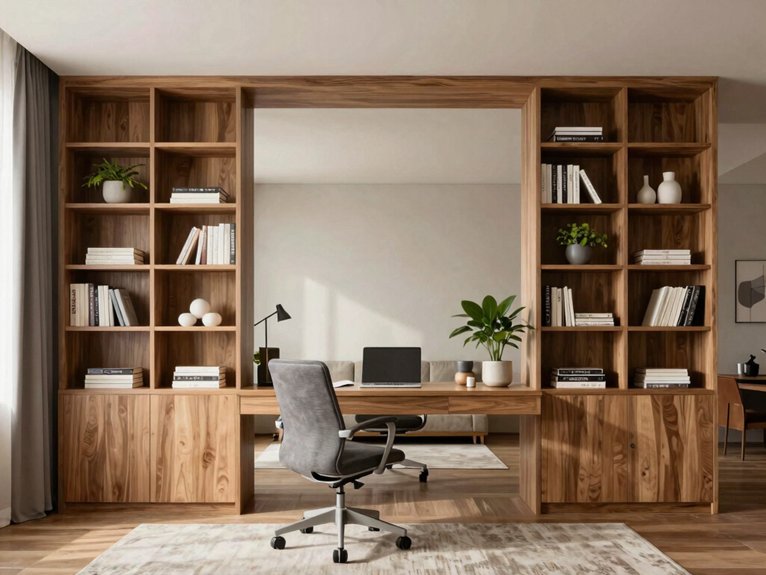
I’ve found that a see-through five-by-five shelf or a back-to-back pair of IKEA BILLY bookcases can give you privacy without stealing all the daylight, which is a gift when your “office” is also your kitchen table.
You’ll get room for books, chargers, and the random notebook you swear you’ll find later, and an open-back étagère or KALLAX-style unit can keep the space bright while still marking off your work zone.
If you need real focus, I’d use a stable, anchored divider so your desk area feels steady and calm—because nobody needs a wobbly shelf during a Monday deadline.
Privacy With Natural Light
For my home office, I’ve found that a bookcase divider can do a sneaky-good job of giving you privacy without turning the room into a cave. You get daylight privacy and keep the space friendly. I like open-back étagères and translucent partitions because they let sun drift through while marking your work zone.
- Try a half-wall bookcase, about 3 to 4.5 feet high.
- Place two IKEA BILLYs back-to-back in the center.
- Finish the back with plywood or wallpaper for polish.
- Use a freestanding open shelf or louvered screen if you rent.
Anchor tall units. My kids call that “no tippy drama.”
Storage For Work Essentials
When you need your divider to work harder, a bookcase can pull double duty as a storage wall and a room separator. I’ve used paired IKEA BILLY units in my family’s loft, and they hide the desk mess beautifully.
| Option | Best use |
|---|---|
| Back-to-back shelves | Files and books |
| Open-backed étagère | Light flow |
| Half-wall bookcase | Monitors and gear |
| Drawers/doors | cable management |
| Plywood finish | Polished back |
You can stash supplies, keep ergonomic storage close, and still leave a 3-foot path. I strap tall units to studs; gravity’s rude.
Stable Zones For Focus
A bookcase divider can turn your office nook into a stable zone for focus, and I’ve seen that work firsthand in my family’s 400-square-foot Chicago studio.
You can use two IKEA BILLY bookcases back-to-back, and they’ll hide the desk while giving you storage that actually earns its keep.
- Choose a 3- to 4.5-foot unit for privacy and light.
- Anchor tall shelves to studs with straps.
- Keep a 3-foot passage for your chair and feet.
- Add acoustic panels and keep focus rituals nearby.
I like open-backed shelves too; they feel friendly, not fortress-like.
Bookcase Divider Ideas for Entryways
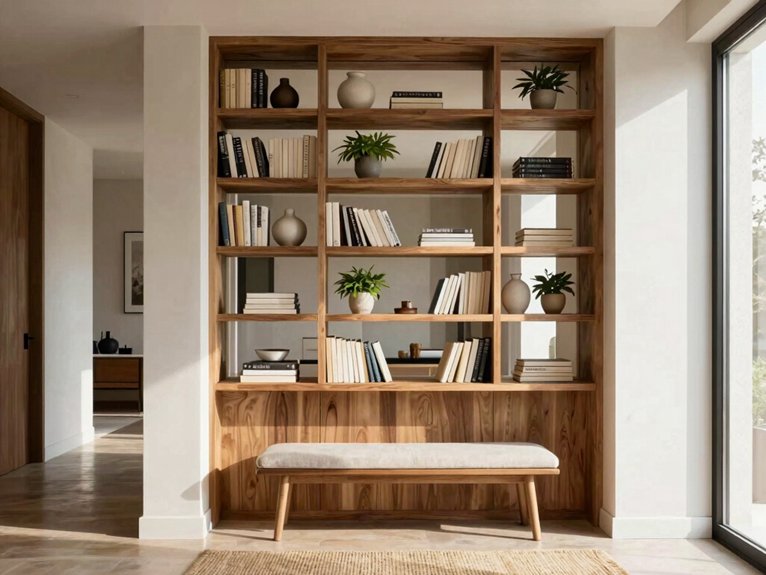
I love how a bookcase can pull double duty and set the tone the moment you walk in.
In my home, I’d use one near the door to create a friendly landing spot with coat hooks, shoe storage, and a few favorite photo books. A low, 2.5- to 4-foot piece keeps sightlines open, while a five-by-five open-back unit lets light breathe in a tiny entry. I’d add baskets, a slim bench, or even two shelves back-to-back. It feels welcoming, not crowded, and your guests won’t trip over the “where do I put this?” chaos.
Bookcase Divider Ideas for Dining Rooms
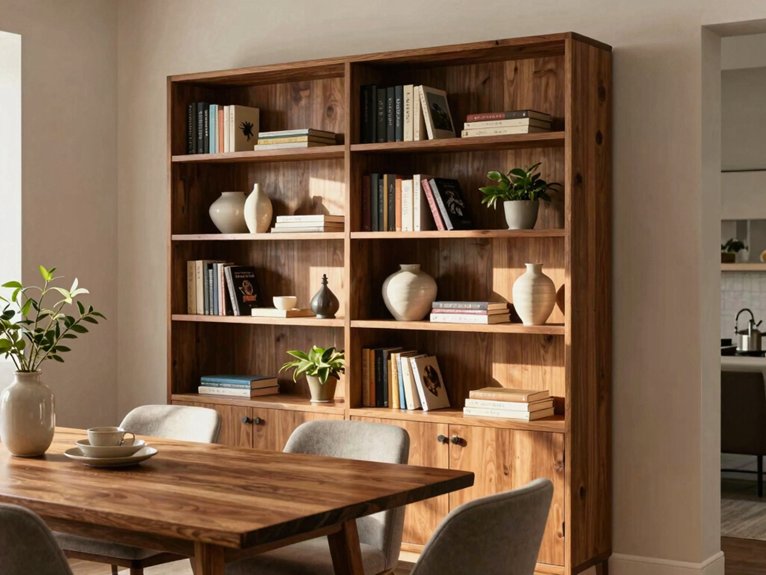
You can use an open-backed bookcase to split your dining room from the rest of the space, and it’ll keep light moving so the room still feels friendly, not boxed in.
I like square units such as IKEA KALLAX or EXPEDIT-style shelves because they hold dishes, cookbooks, and décor while quietly marking a dining zone—my family always ends up debating which shelf gets the good plates.
If you want a bigger statement, pair two bookcases back-to-back or choose a half-wall height piece, and you’ll get storage that does real work without stealing the show.
Open-Back Dining Separation
Bookcase diplomacy works surprisingly well in dining rooms. You keep the room feeling connected, not boxed in, and that helps everyone relax. I love open back aesthetics because they let light pass through and keep the vibe friendly. With smart circulation planning, your family can move from table to sofa without doing a tiny obstacle course.
- Try a see-through five-by-five étagère for dishes and plants.
- Use a half-height unit for lamps or serving pieces.
- Pick KALLAX-style squares for a soft, semi-transparent screen.
- Anchor a double-sided piece so it won’t wobble during dinner chatter.
Storage That Defines Zones
If the open-back look gave your dining room a friendly feel, storage can take that idea one step farther and help set clear zones without making the space feel boxed in. I’d choose floor-to-ceiling built-ins for a grand split, or a 5×5 étagère when I want light to flow. Half-wall bookcases are great for my family’s serving platters and “where did I put that?” moments. | Option | Best use |
| — | — |
|---|---|
| Built-ins | Strong division |
| Double-sided units | Hidden clutter |
| Open shelves | Bright display |
| Console height | Easy staging |
| Trimmed backs | Feature wall |
Add seasonal styling and simple maintenance tips; use anchors, too.
Bookcase Divider Ideas for Living Rooms
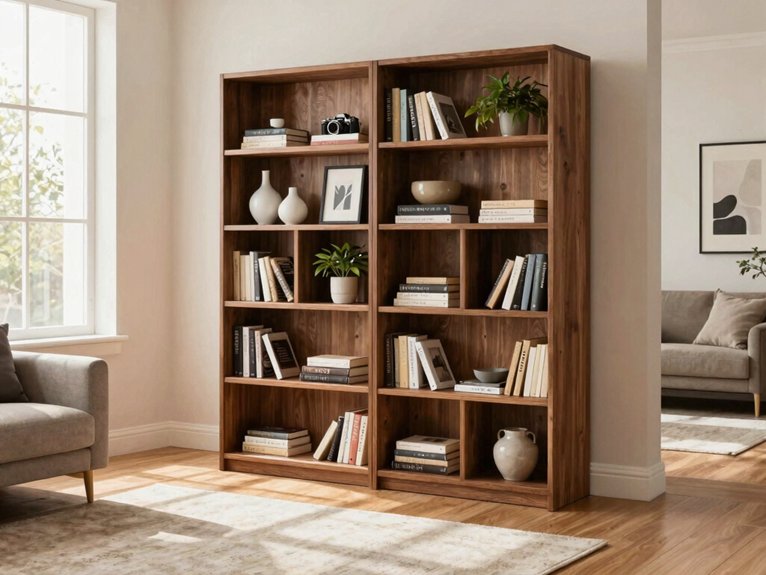
When I want a living room to feel split without losing its calm, I turn to a shelf-divider setup. I’ve found open-backed étagères, like a 5-by-5 cube, keep sunlight moving, and my family still feels together.
- Use lighting placement to warm the edges.
- Add acoustic treatment with rugs and curtains nearby.
- Try back-to-back bookcases for a stable center line.
- Pick half-wall-height shelves for books, plants, and a little mystery.
In my home, a BILLY pair or KALLAX unit holds our stories and hides clutter, without making the room feel like a fort.
Bookcase Divider Ideas for Rental Spaces
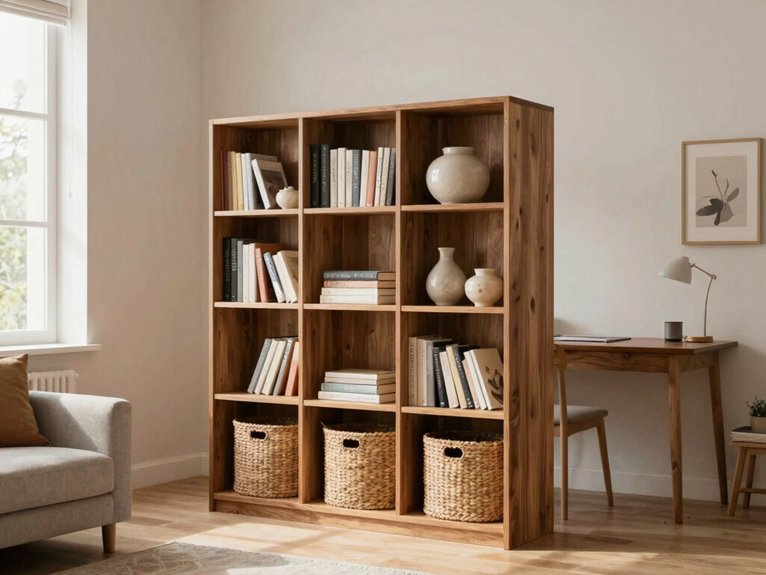
In my rentals, I like room dividers that work hard and leave no scars. You can use open-backed étagères, like a see-through five-by-five shelf, to create temporary partitions that keep light moving and still give you a cozy nook.
I’ve also seen two IKEA BILLY bookcases placed back-to-back in a studio, and that trick adds storage without wall holes. Low bookcases, about 2.5 to 4 feet tall, help you zone a room while keeping sightlines open.
For modular shelving, finish seams with removable wallpaper or trim, then take it all with you when lease day rolls around.
Bookcase Divider Ideas in Bold Colors
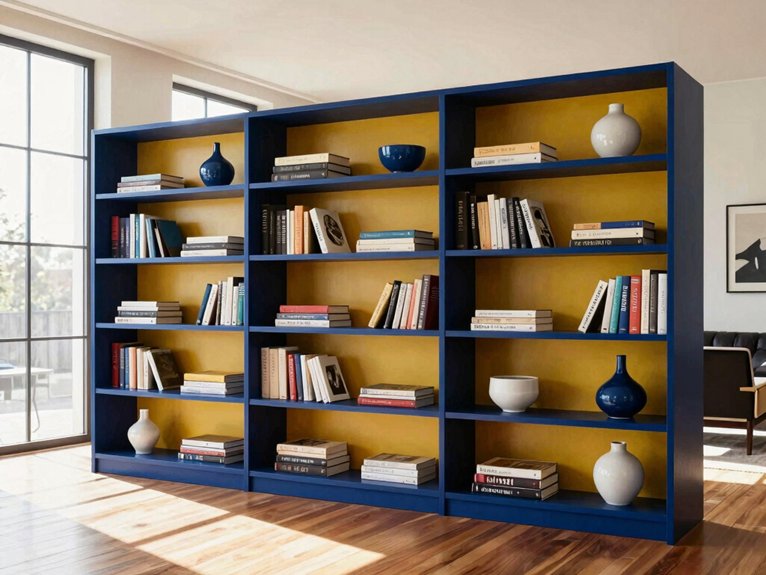
For a room divider that doesn’t whisper, I go straight to bold color. I’ve seen a bubblegum-pink, floor-to-ceiling bookcase split a tiny D.C. studio and still feel like home. You can do that too.
- Paint the backs robin’s egg blue for a Neon backdrop.
- Use a low, pink shelf to keep sunlight moving.
- Try a vintage hutch you can repaint later.
- Push two units back-to-back for Chromatic contrast; add trim at the seam.
My family loves this trick because it marks zones fast, and nobody trips over a gloomy wall pretending to be furniture.
Warm Wood Bookcase Divider Ideas
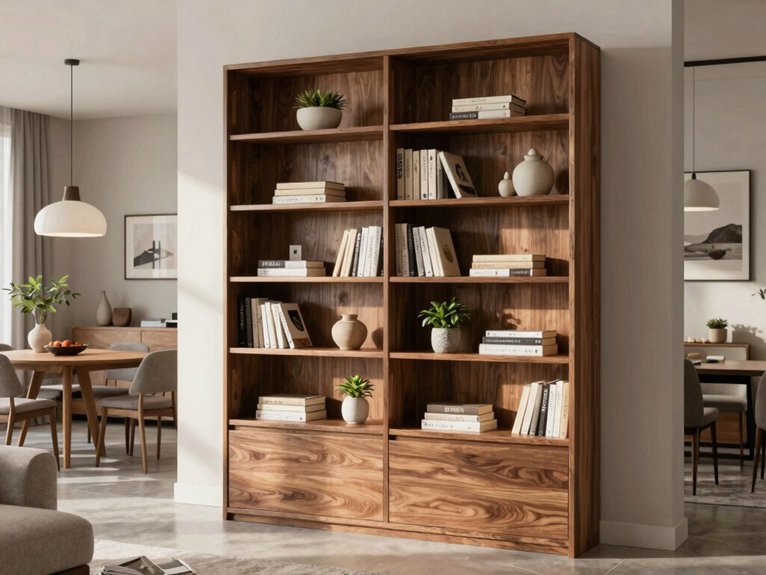
Warm wood has a way of making a room exhale. I love how warm wood bookcases turn a chilly space into one that feels lived in, even on a tight budget.
In my family, we’ve used timber tones to carve out a reading nook and keep books close, not banished to a corner. Try low consoles at 2.5 to 4 feet for light, or go floor-to-ceiling for a strong wall. For a central spot, I’d pair two bookcases back-to-back and hide the seam. That grain pairing looks polished, cozy, and just a little smug.
Repurpose a Hutch as a Divider
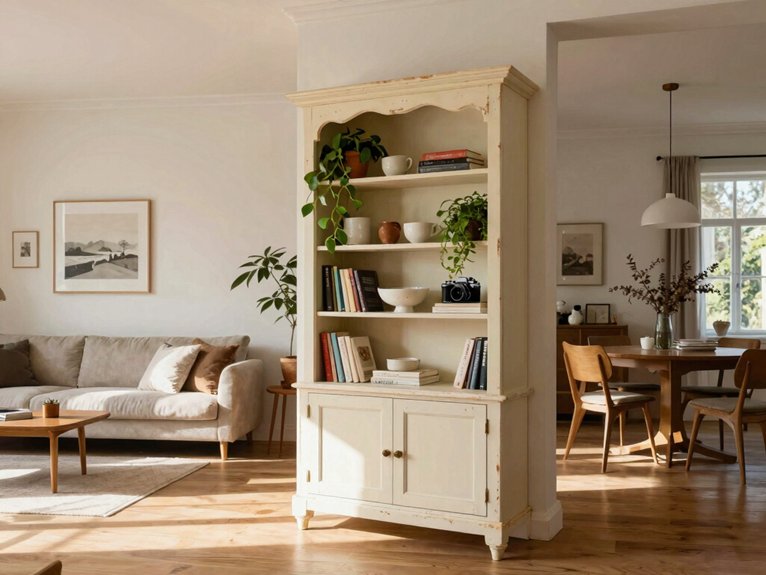
An old hutch can do more than hold dishes; it can quietly become the room’s best separator. I’ve seen one split a kitchen from a dining nook, and it felt instantly welcoming.
You get drawers, cupboards, and shelves, so your stuff finally has a home. I like the antique styling too; it warms up bare, industrial rooms fast.
- Anchor it for structural reinforcement.
- Place it back-to-back if it sits center stage.
- Paint the back, add wallpaper, or hang art.
- Choose a sturdy oak or pine piece.
Your family’ll feel the change right away.
Style the Shelves Without Clutter
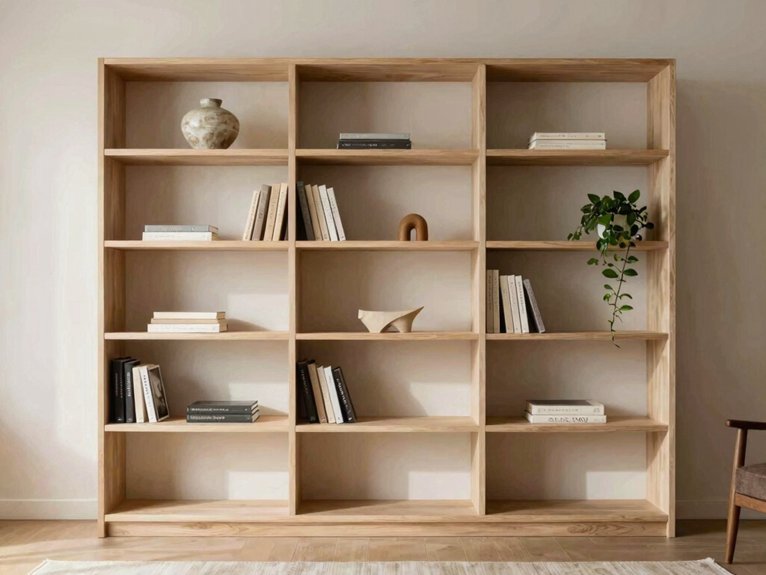
When I style shelves, I keep a firm hand on the stuff and let a few good pieces do the talking. I tuck most books behind a lower console or half-wall bookcase, then build curated vignettes with 3 to 6 items per shelf.
You can group books by color, add one framed photo, and set a small plant beside it. Leave negative space so the whole divider feels calm, not like it swallowed a library. I like open-backed étagères, because they keep sightlines airy. Hide extras in drawers, and nobody has to know your family owns twenty-seven mugs.
Mix Books, Plants, and Art
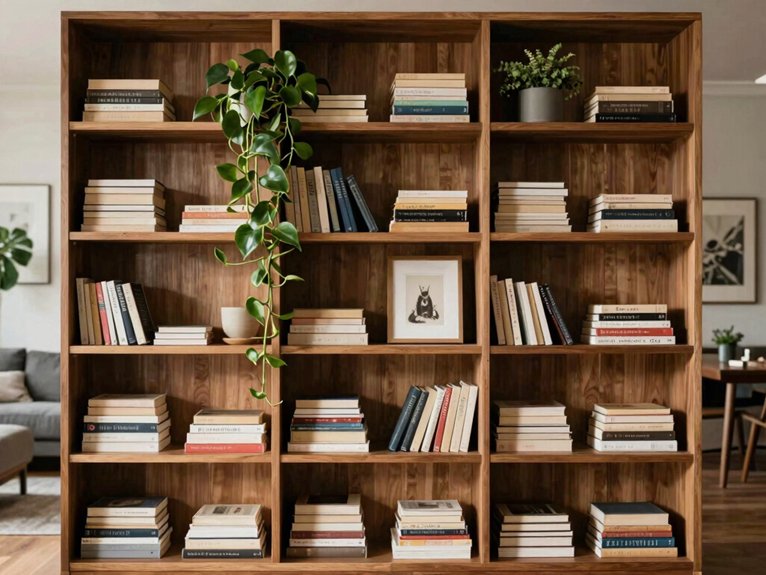
I often mix books, plants, and art on a see-through five-by-five shelving divider, because it lets light slip through while still giving the room some real shape. You can do this too, and it feels welcoming, like your nook knows your name.
- Stack a few scented books flat, then stand up favorites beside them.
- Add potted pothos or a trailing philodendron on upper squares.
- Slip in botanical prints or small framed art between rows.
- Put candles or trinkets below for warmth.
I like using a bold back panel, since it makes the whole divider feel finished, not fussy.
Anchor Your Bookcase for Safety
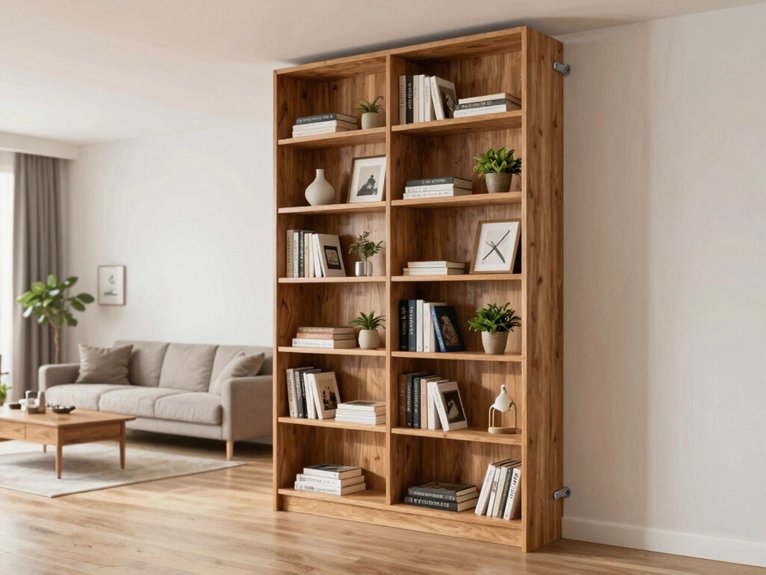
Safety first, because a pretty bookcase shouldn’t moonlight as a wobble machine. I always use secure anchoring, and you should too. My family’s IKEA KALLAX stays put with anti-tip straps; it’s peace of mind with style. For a room divider, check this quick guide:
| Setup | Fix |
|---|---|
| Tall unit | Strap to studs |
| No studs | Use toggle bolts |
| Back-to-back pair | Fasten, then anchor |
Put heavy books low, light decor up top. Follow the maker’s anti-tip steps, and you’ll get real tip prevention without drama. Your home feels safer, steadier, and more like yours.
Finish the Back for Two-Sided Appeal
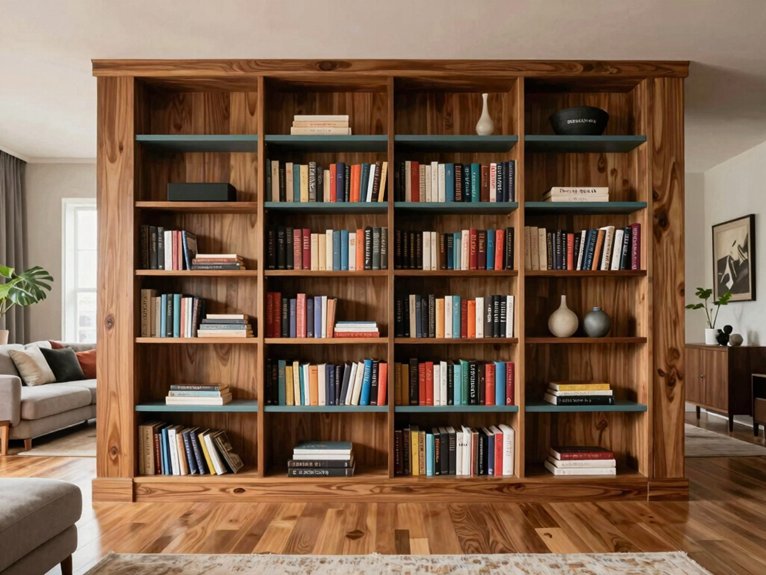
- Paint the back like a wall.
- Add shiplap or beadboard.
- Use removable finishes for rentals.
- Hide veneer seams with trim and styled books.
A finished back helps your divider feel welcoming, polished, and ready for everyday life.
Make It Feel Built In
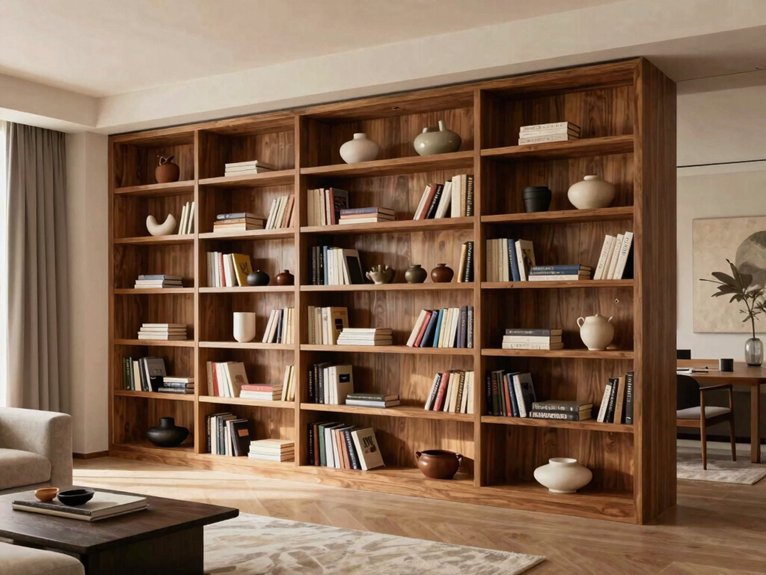
If you want your room divider to look like it was always part of the house, built-ins are the gold standard, and I say that as someone who’s spent way too much time staring at bookcases and thinking, “Could this pass for original trim?”
Floor-to-ceiling shelves create a big, calm wall of storage, and off-white finishes keep them from feeling heavy, which is handy if you’re splitting a primary bedroom from the main living area. I’d add trim or crown molding, then use seam concealment and faux cabinetry touches, because nothing says “I belong here” like a divider that quietly fits.
Bookcase Divider Ideas for Any Budget
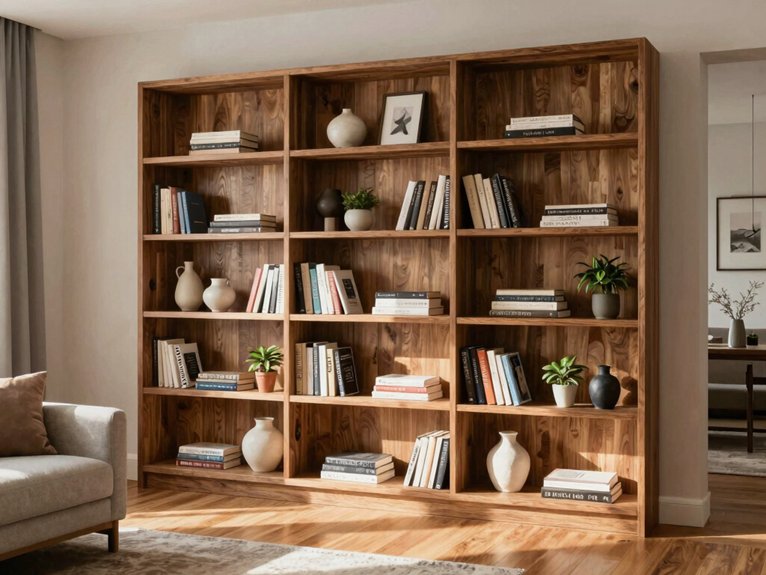
Three kinds of bookcase dividers can fit almost any budget, and I’ve learned that the right one depends less on style dreams and more on how much light, storage, and money you’ve got. I’ve used them in family spaces, and they feel like instant community.
- Open-backed étagères keep rooms bright.
- Half-wall units add privacy without a cave vibe.
- Two back-to-back bookcases are my favorite budget solutions.
- Folding louvered shelves, about $120–$210, give easy vertical storage.
If you’ve got a studio, try see-through five-by-five shelving. If you’re a collector, built-ins can wait for a bigger wallet.
How to Choose the Right Divider?
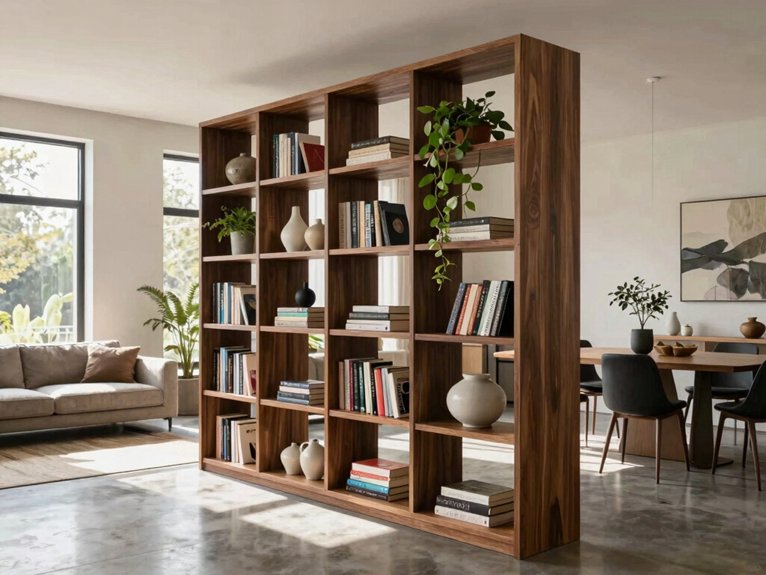
When I’m choosing a room divider, I start with what the space needs most: light, privacy, storage, or all three trying to get along. I’ve learned open-back étagères and square shelves like IKEA KALLAX keep visual continuity and let sunlight wander through.
If you rent, I’d pick freestanding units, like a console or two bookcases back to back, so you can move them later without drama. I match height to job: low for zones, half-wall for cardio hiding, tall for full cover. I always leave 3 feet for traffic flow and use anti-tip kits.
Frequently Asked Questions
Can a Bookshelf Divider Improve Acoustics Between Rooms?
Yes, your bookshelf divider can boost acoustics a bit, offering sound dampening and privacy improvement. Like a trusty troubadour, it softens echoes, and you’ll feel more comfortably at home together, though it won’t block everything.
What Weight Limits Should Shelf Dividers Support?
You should choose shelf dividers with load capacity matched to your books, décor, and daily use; check material strength first. If you’re sharing space, you’ll feel better with sturdy shelves that support everyone’s stuff.
How Do You Hide Cords on a Bookcase Divider?
You can hide cords by routing them along the back, using cord concealment clips and cable raceways, then tucking excess length behind shelves. You’ll keep things tidy and feel right at home.
Can Rolling Bookcases Work as Temporary Room Dividers?
Yes, rolling bookcases can work well as temporary room dividers. You’ll create flexible space zoning, and 70% of renters value mobile storage for that just-right sense of belonging, comfort, and control in shared rooms.
How Do You Clean and Maintain Divider Shelves?
You dust divider shelves weekly with microfiber cloths, then wipe spills right away. You’ll keep finishes warm with occasional wood polish, tighten screws, and rotate items so your shared space feels cared for and welcoming.